Five days ago the U.S. Supreme Court handed down a unanimous decision that will reshape the freight industry for years. Most drivers haven't heard about it yet. By the end of this article, you'll understand why it matters more than almost any trucking news story in the last decade — and why it's directly good for you.
What Happened
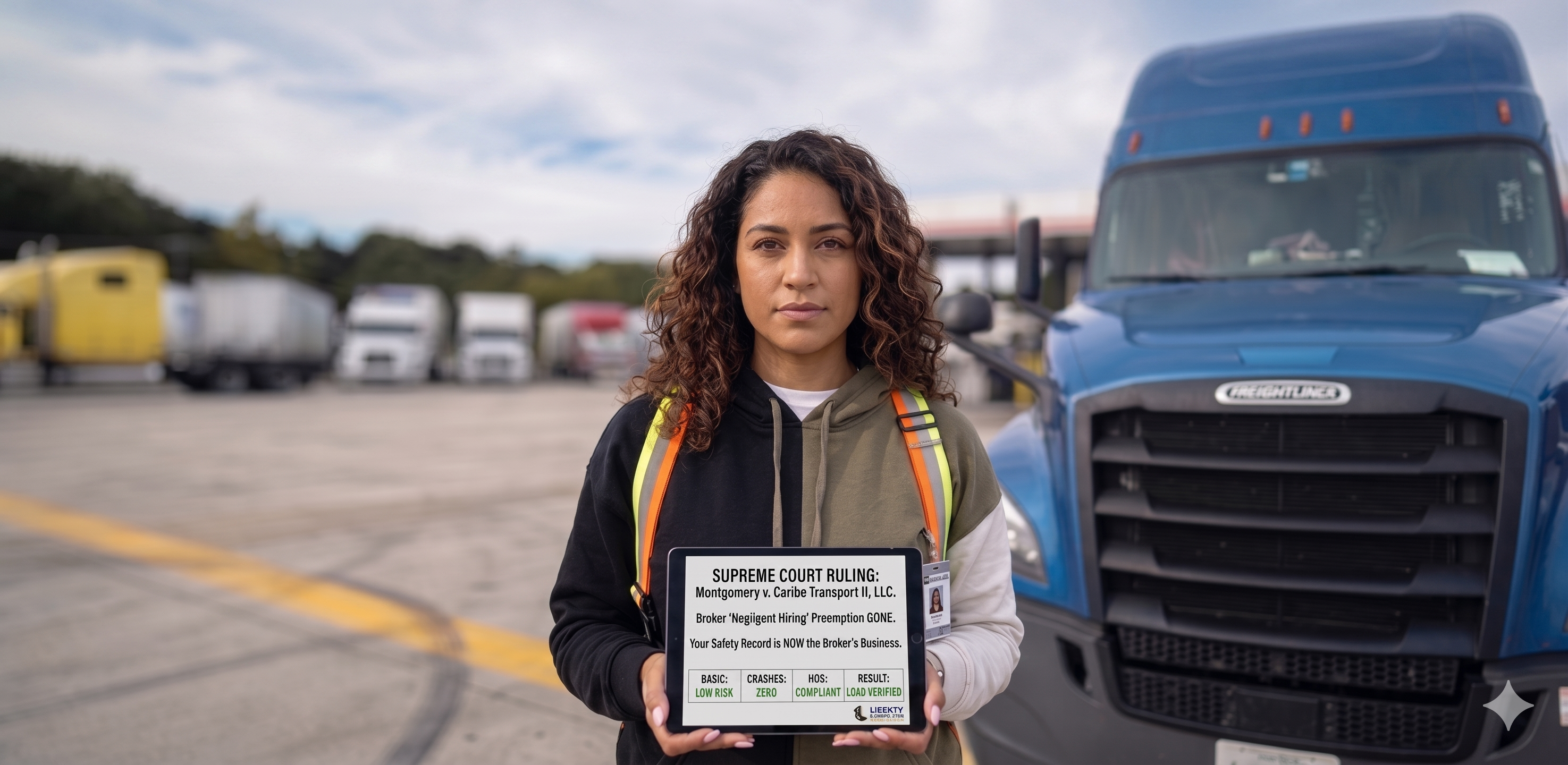
On May 14, 2026, the Supreme Court ruled 9-0 in Montgomery v. Caribe Transport II, LLC that freight brokers can be sued under state law when they negligently hire unsafe carriers.
The plaintiff, Shawn Montgomery, lost his leg when a Mack truck operated by Caribe Transport veered off course on an Illinois highway. C.H. Robinson — the nation's largest freight broker — had coordinated the shipment. Montgomery alleged that the broker should have known the carrier it dispatched had a "conditional" safety rating and a documented history of driver-qualification deficiencies, and that hiring such a carrier breached an ordinary duty of care. ProTrans
The 9-0 opinion was authored by Justice Amy Coney Barrett. The ruling strips freight brokers of the federal preemption shield they have used for decades to avoid responsibility when the carriers they dispatch cause catastrophic highway crashes. ProTrans
For nine years, Shawn Montgomery — a truck driver who was parked on a shoulder doing nothing wrong — had no legal recourse against the broker who put an unsafe carrier on the same road as him. That changes now.
What Brokers Were Getting Away With
To understand why this ruling matters, you need to understand the legal shield that just got removed.
The Federal Aviation Administration Authorization Act of 1994 — the FAAAA — was designed to deregulate interstate trucking by preventing a patchwork of state laws from governing freight prices, routes, and services. Freight brokers had been successfully arguing for years that this law also shielded them from any lawsuit claiming they negligently hired an unsafe carrier.
That defense — first cemented by the Seventh Circuit in Ye v. GlobalTranz in 2023 — created what Justice Kavanaugh, in his concurrence, called a "black hole" of accountability. The federal government had imposed no meaningful safety regulation on broker hiring practices, and state tort law had been blocked from filling the gap. Brokers could legally book the cheapest available truck without checking its safety record, and if that truck killed someone, the broker's exposure would often disappear in a motion to dismiss. ProTrans
Read that again. Brokers could book the cheapest available truck without checking safety records, and when that truck caused a catastrophic crash, they could walk away. The driver — or in this case, a stopped driver who had nothing to do with the crash — had no legal recourse against the entity that chose to put an unsafe carrier on the road.
That's over.
What the Court Actually Decided
The legal question came down to one phrase in the FAAAA's safety exception. The law says preemption "shall not restrict the safety regulatory authority of a State with respect to motor vehicles."
The court asked one question: Is a negligent-hiring claim against a broker a claim "with respect to motor vehicles"? Justice Barrett's answer was yes. Requiring C.H. Robinson to exercise ordinary care in selecting a carrier concerns motor vehicles — most obviously, the trucks that will transport the goods. Assetworks
Barrett acknowledged the FAAAA's anomalies and loose ends. Then she wrote the line that will be quoted in every brief filed in this area for the next decade: "Better to live with the mystery than to rewrite the statute." Assetworks
Justice Kavanaugh's concurrence noted that the ruling "should not be read to mean that brokers will routinely be subject to state tort liability in the wake of truck accidents." Brokers who exercise reasonable care and document their carrier selection decisions remain well-positioned to defend claims. The legal standard going forward is ordinary care — the same standard that already applies to motor carriers and most other businesses. Commercial Carrier Journal
The short version: a broker who genuinely vets their carriers and documents that process is not automatically liable when an accident happens. A broker who books the cheapest available truck without checking its safety record and that truck causes a crash? Now they face a jury.
Why This Is Directly Good for CDL-A Drivers
This ruling changes the economics of unsafe trucking in ways that directly benefit every driver on the road.
Brokers will stop booking carriers with conditional safety ratings. Brokers under new liability pressure will increasingly steer freight to carriers they can defensibly select. Treat CSA scores as a business priority — brokers under new liability pressure will increasingly steer freight to carriers with clean records. Truckers Flow
That means the carriers competing for freight will increasingly be the ones who maintain their equipment, comply with HOS rules, and don't pressure drivers to violate safety regulations. The carriers who've been cutting corners and winning freight from brokers on price alone face a structural disadvantage now that didn't exist last week.
Your clean record becomes more valuable. Drivers with clean CSA scores and PSP records are the asset that safe carriers need in order to keep winning broker freight. The demand for qualified, documented, compliant CDL-A drivers just went up. Every freight decision a broker makes going forward will be made with one eye on whether that carrier and its drivers can be defended in court if something goes wrong.
The chameleon carrier ecosystem takes another hit. Chameleon carriers — the ones that disappear and reopen under new DOT numbers after accumulating violations — were exactly the kind of carrier that lived in the accountability gap this ruling just closed. A broker who knowingly dispatches a carrier connected to a network of prior violations is now exposed. That exposure makes the business model of running unsafe freight under fraudulent authority significantly harder to sustain.
Roads get safer. Justice Kavanaugh noted that nearly 5,000 people died in truck-related accidents in 2022 alone. "Truck safety is a matter of life and death," he wrote, adding that brokers who perform "hard questions" and hire reputable carriers should still be able to successfully defend themselves in court. The economic incentive to cut corners on carrier selection just inverted. Brokers now have financial skin in the game on every carrier they dispatch — and that changes behavior faster than any regulation. Commercial Carrier Journal
What Changes in Practice — And When
The first wave of negligent-hiring suits against brokers is expected within weeks. The insurance market will take time to respond, but brokers will face increased scrutiny on their carrier-vetting processes, including the documentation behind those decisions. Truckers Flow
Practically, here's what changes:
Carrier vetting gets more rigorous. Brokers that previously ran minimal safety checks will build formal vetting processes — documented CSA reviews, PSP checks, conditional rating screening. The logic applies to anyone in the supply chain who selects a carrier and has access to publicly available safety data showing that the carrier presents an elevated risk. Assetworks
Conditional-rated carriers lose freight access. A carrier with a conditional safety rating is now a legal liability for any broker who dispatches them. Expect conditional-rated carriers to face sharply reduced broker freight availability until they resolve their safety deficiencies — or exit the market.
Documentation becomes everything. The question a court will ask is whether the broker acted reasonably in selecting the carrier: Did they review available safety data? Did they have a documented vetting process? Did they identify and address red flags? Brokers will build paper trails. Carriers will be asked to provide documentation they've never had to provide before. Truckers Flow
Rates adjust. Trucking producer price indexes leapt about 20% year over year in April — and the Montgomery ruling adds another layer of cost pressure on brokers who will need to invest in vetting infrastructure and insurance coverage for negligent-selection exposure. Some of that cost flows through to freight rates. The cheapest load on the board gets less cheap when the broker pricing it has legal skin in the game on carrier selection. TopMark Funding
The Bigger Picture
The Montgomery decision lands in the same week that Roadcheck 2026 is wrapping up, the DOT's one-year cleanup report is circulating, and the industry is still absorbing the fallout from the Super Ego investigation. None of these stories are coincidental.
The trucking industry is in the middle of a multi-front accountability reckoning. Chameleon carriers being prosecuted. Fraudulent CDL schools removed. Unqualified drivers placed out of service. ELD tampering now an automatic OOS. English proficiency being enforced. And now — brokers who book unsafe carriers being exposed to jury trials in all 50 states.
Each of these forces pushes in the same direction: toward a market where safety record matters, where documentation matters, where the CDL-A driver who has done things right for years finally gets the competitive advantage that their record deserves.
The FAAAA was an economic deregulation statute. It was not a safety deregulation statute. Congress left state tort suits against trucking companies fully intact. It is hard to read the statute as written and conclude that Congress "subtly sliced and diced state tort law" so that trucking companies face liability for accidents but brokers get complete immunity from the consequences of selecting the carrier that caused the accident. Assetworks
Nine justices agreed. The free pass is gone.
At OTR Express Group, we've always placed drivers with carriers that pass vetting — clean DOT history, real safety ratings, legitimate operations. The Montgomery ruling doesn't change how we operate. It validates why we operate that way. If you're a CDL-A OTR driver who wants to be on the right side of this industry's accountability shift, reach out.
OTR Express Group | CDL-A OTR Driver Recruiting