The freight market finally turned. Spot rates are climbing. Capacity is tight. Carriers are competing for drivers again after four brutal years.
So why are so many drivers and small operators still feeling squeezed?
The American Transportation Research Institute released its 2026 Analysis of the Operational Costs of Trucking on July 15, and the answer is right there in the numbers. Rates went up — but costs went up faster, and they've been climbing for years.
Here's what the report found and what it actually means for your paycheck.
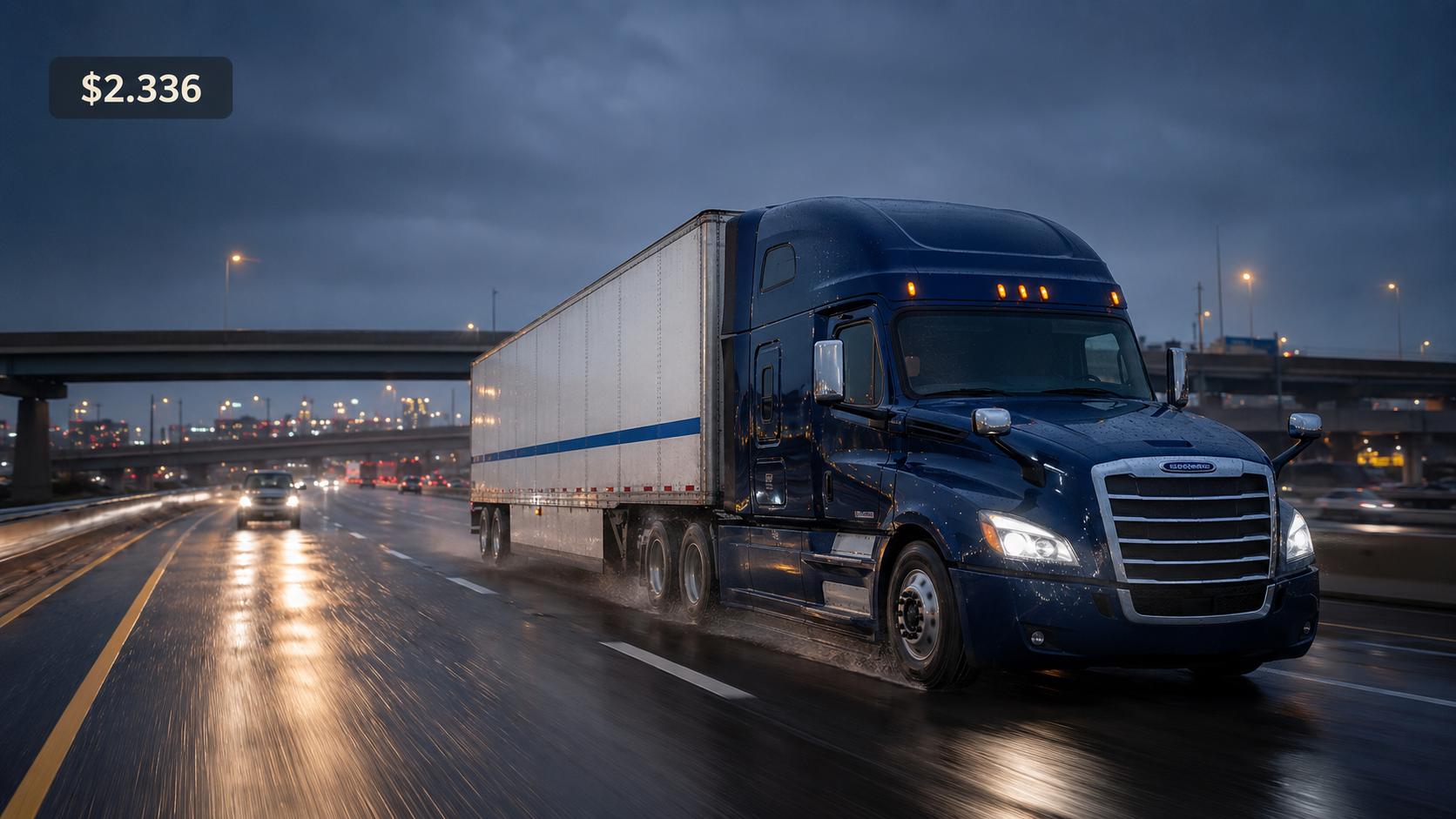
The Headline Number: $2.336 Per Mile
The industry-average cost to operate a truck in 2025 was $2.336 per mile — 3.4% higher than the previous year and the highest per-mile cost in the report's history. PR Newswire
Strip out fuel and the picture gets worse. Excluding fuel, costs rose by 4.2% to $1.854 per mile. That increase outpaced the year's 2.7% consumer inflation rate by 1.5 percentage points. PR NewswireCommercial Carrier Journal
In other words: the non-fuel cost of running a truck is rising faster than the cost of everything else in the economy. That's the real story behind why the recovery feels thinner than the headlines suggest.
Where the Money Is Going
Costs were up in all major line-items in 2025, with the largest percentage gains in tolls (13.2%), repair and maintenance (8.6%), driver benefits (6.6%), and tires (6.4%). PR Newswire
Look at that list carefully — it tells a story.
Tolls up 13.2%. The single biggest jump. Every state looking to fund infrastructure is reaching for toll revenue, and commercial vehicles pay the most.
Repair and maintenance up 8.6%. This is the deferred maintenance bill coming due. Four years of stretched service intervals and aging equipment have caught up with the industry. ATRI notes repair and maintenance costs are likely to continue rising at elevated rates. Heavy Duty Trucking
Tires up 6.4%. Raw material costs and tariff pressure feeding straight into a consumable every truck burns through.
Driver benefits up 6.6%. Health insurance costs continue climbing across every industry, and trucking is no exception.
The Line That Should Get Every Driver's Attention
Here's the part that matters most for anyone behind the wheel.
Only two line-items rose at sub-inflationary rates: fuel and, for the second year in a row, driver pay. PR Newswire
Read that again. Driver pay rose slower than inflation — for the second consecutive year. Every other cost of running a truck went up faster than the economy. Driver wages didn't.
This was the second year in a row in which the rate of growth in driver benefits costs outpaced driver wages as one of the fastest-rising line-items. Commercial Carrier Journal
So the carrier's cost of employing you went up — but most of that increase went to your health insurance premium, not your CPM.
That's the gap. And it's the gap you should be closing right now, while the market gives you leverage to do it.
What Carriers Did to Survive
The report also documents just how hard carriers cut to make it through.
Truck counts declined 2.4%, marking the largest reduction in freight capacity since the freight recession began in 2022. Fleets also reported an average of 10% of trucks sitting unseated, increased average truck age and annual mileage, elevated deadhead mileage, and a 7.8% reduction in non-driver staffing. FleetOwner
Ten percent of trucks sitting empty because there's no driver in them. Older trucks running more miles. Fewer support staff. That's what four years of recession did to the industry.
And even after all that cutting: carrier profitability remained poor. Operating margins in the truckload and refrigerated sectors improved slightly but were still below 1.0%, while tank carriers averaged 4.0%. Only LTLs and fleets with more than 1,000 trucks had healthy — but flat — margins in 2025. DC Velocity
Sub-1% operating margins in truckload. That's the thinnest possible cushion. It explains a lot about why so many small carriers folded.
2026 So Far: The Trends Are Continuing
The first-quarter data doesn't show relief. Financial data for Q1 2026 show that insurance, driver benefits, and toll costs continued to rise at an elevated rate. Insurance premiums were up 6.4%, driver benefits by 4.5%, and tolls by 2.7%. They were joined by fuel costs, which increased by 5.9% in the first quarter after remaining flat through 2025. Heavy Duty Trucking
And fuel isn't done moving. Brent crude rose 2.2% to $91.22 — well above the roughly $72 per barrel level before the war started in late February. The Houthi militant group in Yemen threatened shipping in the Red Sea as the U.S. and Iran exchanged strikes for a tenth consecutive day. Transport TopicsTransport Topics
Goldman currently projects Brent at $80 a barrel in the fourth quarter and $75 next year — predicated on a de-escalation of tensions in the Middle East. That's the optimistic case, and it depends entirely on a conflict nobody can predict. Transport Topics
The Good News Buried in the Report
Here's the thing: rates are recovering, and the cost pressure is exactly what makes the recovery durable.
"Freight rates are finally turning a corner in 2026, but the acceleration of industry-wide costs means that fleets must continue with aggressive cost discipline," said Chad Marsilio, PGT Trucking chief operating officer. Bulktransporter
Current spot market conditions back that up. National average flatbed rates are $3.72 per mile as of July 22 — 6 cents above the May average, with the Southeast highest at $4.05 per mile. And there's little to no sign truckload rate hikes are slowing post-July 4, as tight capacity keeps pricing elevated heading into what's typically a slower season. Scale FundingJournal of Commerce
Rates staying elevated through what should be the summer lull is a strong signal. This isn't a seasonal bump — it's structural.
What This Means for You
If you're a company driver: Your pay has grown slower than inflation for two straight years while everything else your carrier pays for went up. That's not a reason for despair — it's a reason to negotiate now. The market is tight, rates are up, and carriers need qualified drivers more than they have in years. If your CPM hasn't moved recently, bring these numbers to the conversation.
If you're an owner-operator: $2.336 per mile is the industry average — but averages hide everything. Knowing your cost per mile is helpful. Knowing how it compares to similar fleets is far more valuable. Two carriers both spending $2.30 per mile look identical at first glance — but one might have maintenance expenses 25% higher than the industry average, or excessive idle time quietly draining thousands every month. Without benchmarking, those problems remain hidden. Life As A Trucker
Run your actual numbers this month. Fuel, tolls, maintenance reserve, insurance, tires, payment. Compare them to the ATRI benchmark. Whatever line item is furthest above average is where your money is leaking.
If you're thinking about going independent: Go in with eyes open. Costs are at record highs and still climbing. But rates are recovering, capacity is genuinely scarce, and the operators who know their numbers are positioned better than they've been in four years.
The Bottom Line
The freight recovery is real. So is the cost squeeze. Both things are true at once.
What separates the drivers and operators who thrive in this market from the ones who feel stuck isn't luck — it's knowing the numbers. Knowing what a mile actually costs. Knowing what your record is worth. Knowing that driver pay lagged inflation two years running and using that fact in your next pay conversation instead of accepting whatever's offered.
The market finally turned in your favor. Make sure you're actually capturing it.
At OTR Express Group, we place CDL-A OTR drivers with carriers whose pay reflects what this market actually pays — not what it paid three years ago. If you want an honest read on what your experience and record are worth right now, reach out.
OTR Express Group | CDL-A OTR Driver Recruiting