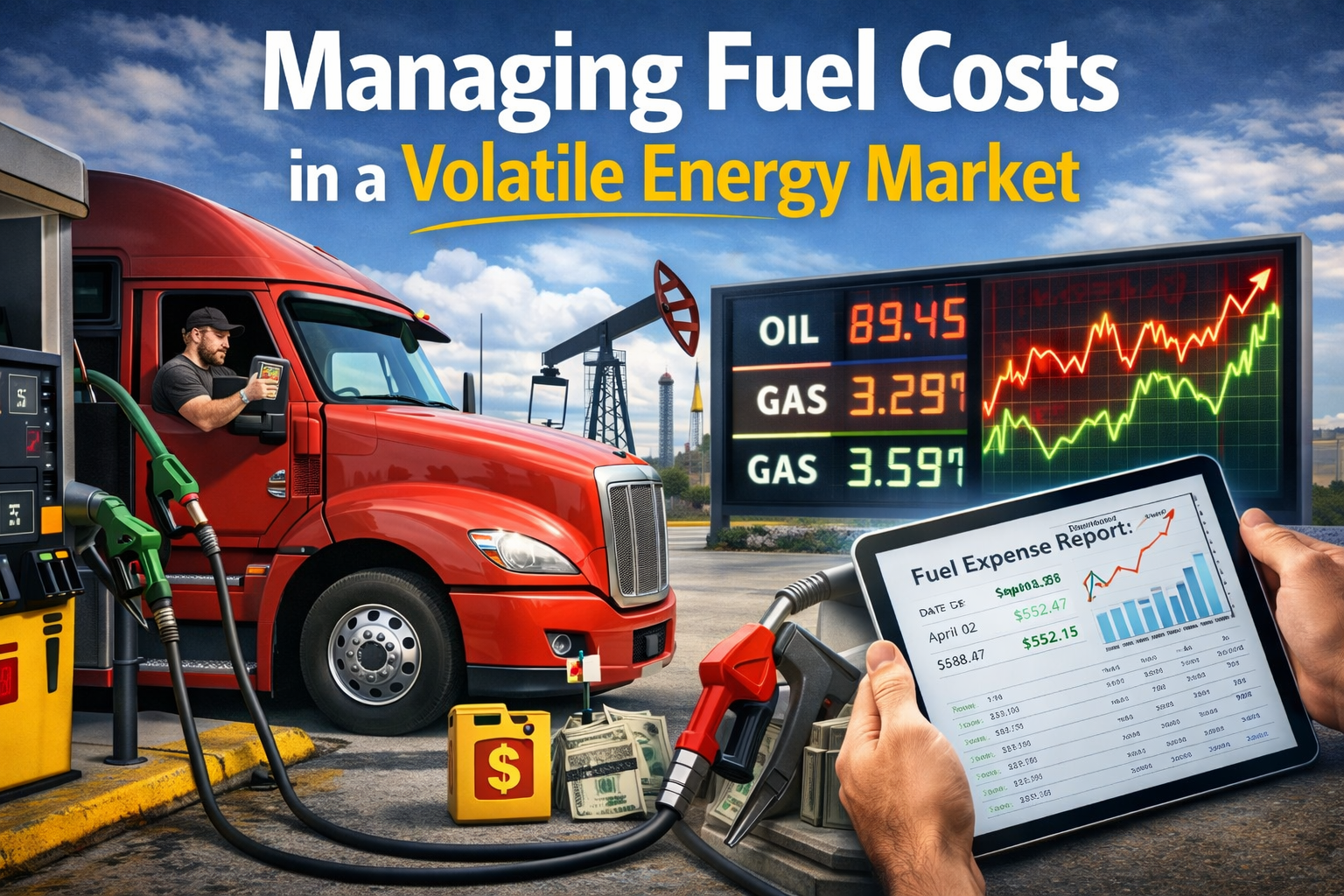
Fuel has always been a major operating cost in trucking. In 2026, it's become one of the most unpredictable variables a driver or owner-operator has to manage — and getting it wrong is expensive.
For many trucking companies in the United States, fuel expenses now represent 30–40% of total operating costs. Hydrox Systems That's not a rounding error. It's the number that determines whether a month ends in the black or not — and right now, it's moving in the wrong direction.
Here's what's driving the volatility, what it means in practical terms, and the specific strategies that actually help.
What the Market Looks Like Right Now
The national U.S. average diesel price was $3.72 per gallon in February 2026, up from $3.52 in January and higher than the same period in 2025. Sustained oil-market volatility could keep upward pressure on fuel surcharges and freight transportation rates going forward. C.H. Robinson
In Q1 2026, the price of diesel fuel rose approximately 10% year-over-year, but ground fuel surcharges rose 26.7% — with businesses being warned to brace for a "new normal" of elevated fuel costs. PR Newswire
Industry data suggests that even a 10% increase in fuel costs can raise freight expenses by 2–4%, putting immediate pressure on margins — and while spot rates are trending upward, those rate increases are not keeping pace with fuel cost inflation. Best Yet Express
The drivers being hit hardest are independent operators and small fleets. Large fleets may have fuel hedging strategies and long-term contracts, but smaller operators face immediate exposure to diesel price swings, with rising fuel costs eating directly into already thin profits. Best Yet Express
The short version: fuel is expensive, unpredictable, and not going to stabilize soon. The drivers and operators who manage it proactively will protect their margins. Those who don't will feel every price spike directly.
What You Can Actually Control
You can't control crude oil prices, refinery capacity, or geopolitical events. You can control your driving habits, your fuel sourcing, and your operational decisions. Those variables add up to real money over the course of a year.
1. Speed Management
This is the single highest-impact fuel efficiency lever available to a driver. Aerodynamic drag increases exponentially with speed — a truck running 65 mph uses meaningfully less fuel than one running 70 mph over the same route.
Most carriers have established speed policies, and ELD-connected telematics tracks compliance. But even beyond policy requirements, slowing down 5 mph on long hauls will show up visibly in your fuel economy numbers over a quarter. Set cruise control. Use it consistently. The fuel savings aren't theoretical — they're measurable.
2. Reduce Idle Time
Drivers who consistently beat MPG targets earn monthly bonuses at many carriers, with smooth acceleration, proper speed management, and reduced idling among the tracked behaviors. Getdoublenickel
Excessive idling is one of the most wasteful fuel habits in trucking. A diesel engine at idle burns approximately 0.8 gallons per hour. If you're idling two unnecessary hours per day, that's over 580 gallons per year spent producing zero forward movement.
Where drivers can reduce idle without sacrificing comfort:
- Use APU or shore power where available for cab temperature instead of running the engine
- Time your pre-warming in cold weather — most modern diesel engines don't need the warm-up times older equipment required
- Shut down during extended dock waits instead of leaving the engine running
3. Use a Fuel Card with Price Optimization
Fuel cards tied to discount networks — Love's, Pilot/Flying J, TA/Petro, TCS, and others — consistently deliver lower per-gallon prices than cash or retail. The discounts are small individually but compound across tens of thousands of gallons per year.
Deadhead miles lead to higher fuel costs without any profit to make up the difference. Route planning tools help reduce empty runs and cut unnecessary detours, and load boards help fill empty trailers to avoid driving miles that only cost money. Truckstop
If you're running your own authority, the fuel card you choose matters. Compare network coverage against your regular routes, not just the discount percentage. A 6-cent discount at a truck stop 40 miles off your route doesn't save money.
4. Preventive Maintenance
Maintained engines are efficient engines — they use less fuel than worn-out parts. Preventive maintenance pays off more than you might think. Truckstop
Specifically for fuel economy:
- Tire inflation — underinflated tires increase rolling resistance and fuel consumption. Check inflation every pre-trip.
- Air filter condition — a clogged air filter forces the engine to work harder. Replace on schedule.
- Fuel injector condition — dirty or worn injectors reduce combustion efficiency. Part of any quality fleet maintenance program.
- Alignment and wheel bearings — dragging bearings or misaligned axles are invisible fuel drains.
The math on deferred maintenance is consistently worse than the math on preventive maintenance. Every dollar skipped on upkeep typically costs more than a dollar in additional fuel spend and repair cost.
5. Route and Load Optimization
Fleet managers adjust route planning to reduce fuel costs by rerouting trucks and limiting load acceptance based on fuel pricing by region. Week-to-week swings make budgeting more complex and can slow efficiency. Truckstop
For owner-operators, this means:
- Prioritizing loads that minimize deadhead miles
- Knowing regional fuel price differences — running through states with lower fuel taxes or better network discounts before topping off
- Avoiding fuel stops near major metro areas where retail diesel consistently runs higher
For company drivers, it means understanding how your carrier's dispatch decisions affect your mileage efficiency — and having that conversation when routes consistently lead to high empty miles or backtrack routing.
6. Terrain-Smart Driving
This doesn't get enough attention. A driver who uses terrain intelligently — building momentum before a grade, letting the truck breathe on downhills, avoiding unnecessary braking and reacceleration — will consistently outperform a driver with the same equipment and route who doesn't.
The specific habits:
- Anticipate hills on familiar routes and time your approach to carry momentum up
- Use engine braking on descents to slow the truck without scrubbing speed entirely, then use that carry-over momentum at the bottom
- Avoid hard braking followed by hard acceleration — every time you do this on the highway, you're converting forward momentum into heat and then burning fuel to rebuild it
Understanding Fuel Surcharges
Fuel surcharges are how carriers recoup fuel cost increases from shippers — but they don't always flow through equally to drivers, especially on percentage-of-load pay structures.
In both contract and spot markets, fuel price hikes are passed through quickly, often reaching 100% within a week — the highly competitive, low-margin trucking industry leaves carriers unable to absorb fuel volatility without risking failure. Supply Chain Management Review
If you're a company driver, understand how your carrier handles fuel surcharges in your compensation structure. If you're an owner-operator, your fuel surcharge terms in broker and carrier contracts directly affect your bottom line. Know the benchmarks those surcharges are tied to — typically the EIA weekly diesel price — and verify they're being applied correctly.
The Owner-Operator Perspective: Treat Fuel Like a Business Variable
For drivers running their own authority, fuel cost management isn't a driving tip — it's a business discipline.
Businesses should plan multiple scenarios — best-case, base, and worst-case for fuel costs — to stress-test their operations. Negotiating fuel surcharges that are fair, transparent, and aligned with projected price trends is also critical. A weekly review of fuel price benchmarks and crude market developments keeps strategy agile. TOP Worldwide
Practically, that means:
- Knowing your exact cost-per-mile including fuel at current prices before accepting a load
- Tracking fuel economy per trip, not just total spend
- Adjusting load acceptance when rates don't cover operating costs at current fuel prices
- Building fuel price assumptions into contract rate negotiations rather than accepting fixed rates during volatile periods
The carriers and owner-operators who treat fuel management as a daily operational discipline rather than a bill to pay at the end of the month consistently run better margins — especially in markets like this one.
The Bottom Line
Fuel volatility in 2026 isn't a short-term problem to wait out. It's a structural feature of the current market, and the drivers and operators managing it proactively are the ones protecting their income. Speed discipline, idle reduction, smart fuel sourcing, proper maintenance, and terrain-smart driving are all in your control — and each one moves the needle.
At OTR Express Group, we place CDL-A OTR drivers with carriers that run efficient operations and handle fuel cost management at the fleet level — so drivers aren't left absorbing volatility alone. If you're looking for a smarter setup, reach out.
OTR Express Group | CDL-A OTR Driver Recruiting