Safety bonuses are some of the most reliable extra money available to a CDL-A driver — and unlike a pay rate negotiation or a market rate bump, they're almost entirely in your control. You decide whether you earn them. Most drivers who miss out on them don't do so because of bad luck. They do so because they're not tracking the right things consistently.
Here's a breakdown of how safety bonus programs typically work, what carriers actually measure, and a practical checklist to make sure you're collecting every dollar you're owed.
What Safety Bonus Programs Actually Pay
Programs vary by carrier, but the structure is fairly consistent across the industry. Many fleets offer escalating bonuses for consecutive months or years without incidents — a driver might earn $200 for six months accident-free, $500 for a year, and $1,000 for two years. The longer you stay safe, the bigger the reward. Getdoublenickel
Some carriers pay $250 per quarter for meeting eligibility requirements — adding up to $1,000 per year just for being a safe driver. Freight X, LLC
Beyond accident-free records, carriers reward drivers for specific measurable behaviors including fuel efficiency, on-time delivery rates at 98% or above, and clean roadside inspections with zero violations. Getdoublenickel
Successful rewards programs are layered — they include different types of compensation and criteria for earning, combining monetary rewards with recognition awards like company clothing, pins, or signage on the driver's vehicle announcing milestone safe mileage. HUB International
The number matters: a driver who earns every available safety incentive at a typical carrier — quarterly accident-free bonuses, fuel efficiency bonuses, and clean inspection bonuses — can realistically add $2,000–$5,000 per year on top of base CPM. That's money sitting on the table for any driver who stays focused.
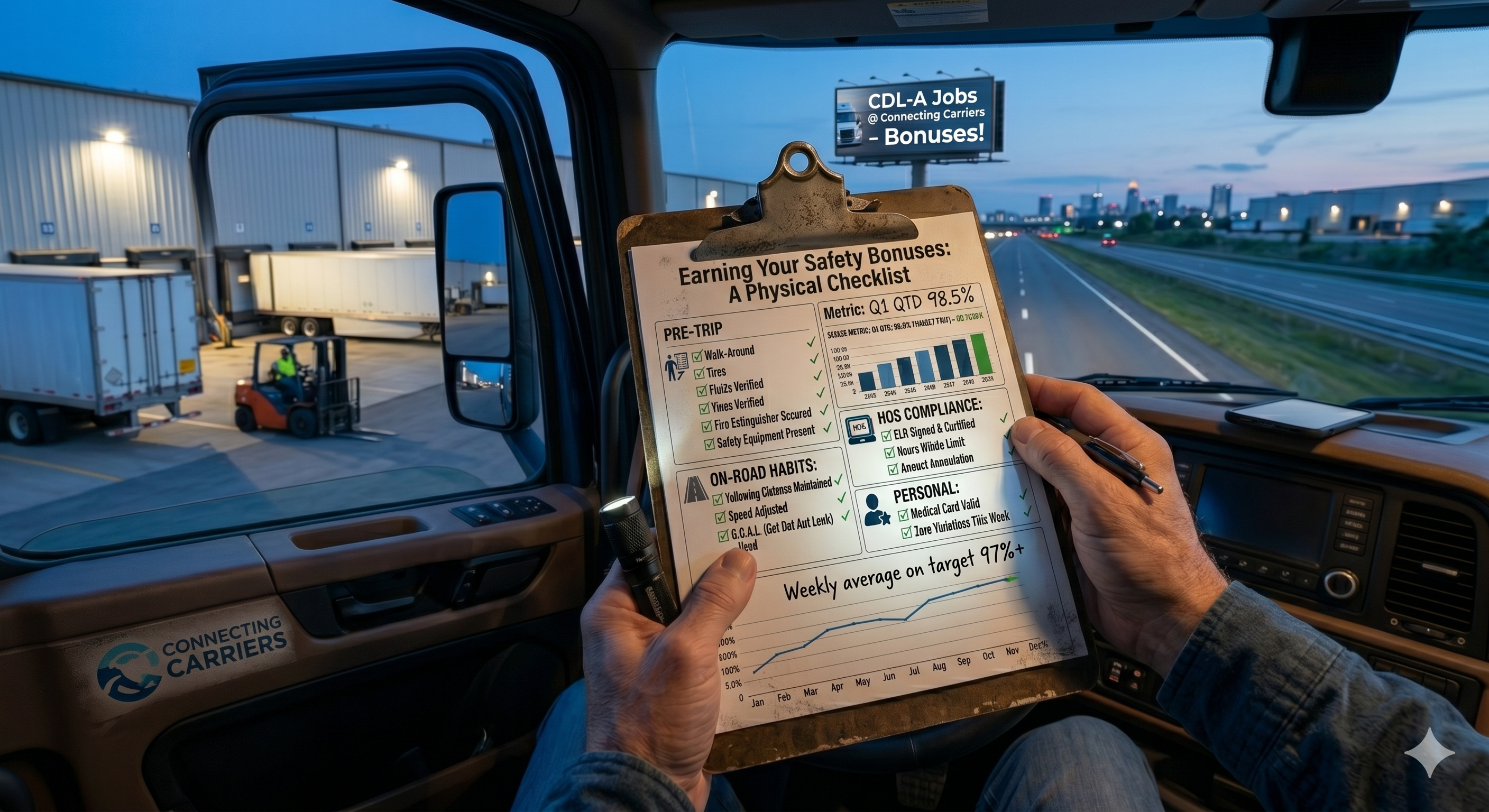
The Checklist: What to Track and Protect
✅ Accident and Incident Record
This is the core of almost every safety bonus program. One preventable accident can wipe out an entire year of bonus eligibility — and in some programs, reset a multi-year streak entirely.
- No preventable accidents. A "preventable" accident is one where you had the last clear chance to avoid it, regardless of who was at fault legally. Know the difference before you make a call.
- No at-fault incidents with other vehicles. Even minor fender-benders on docks or in fuel lanes count.
- Document everything at the scene. Photos, witness info, police reports. If something wasn't your fault, the documentation to prove it starts at the scene, not after the fact.
✅ Roadside Inspections
Passing Level 1 inspections with zero violations earns spot bonuses at many carriers. Getdoublenickel A Level 1 is the most thorough inspection — 37 components examined, driver and vehicle both. Passing one clean is a real achievement and many carriers pay for it specifically.
- Pre-trip every single time. Not a habit, not a routine — every time. A pre-trip that catches a brake issue or a light out before an inspection is a bonus saved.
- Check your lights. Headlights, brake lights, turn signals, clearance lights, marker lights. Burned-out lights are the most common violation on Level 1 and 2 inspections and the most preventable.
- Tires. Tread depth, inflation, sidewall condition. Tire issues are the second most common violation. Carry a tire gauge and use it.
- Brake adjustment. Inspect your brakes as part of every pre-trip. Brake violations carry CSA points that follow you.
- Cargo securement. Proper tie-down count, rated for cargo weight, no visible damage to straps or chains. Cargo securement violations are disproportionately costly in CSA points relative to how preventable they are.
- ELD compliance. Keep your logs clean and current. HOS violations found during an inspection hit your CSA score and disqualify you from most bonus programs immediately.
✅ Hours of Service
HOS violations are an automatic disqualifier for safety bonuses at virtually every carrier, and they generate CSA points that affect your employability and pay for years.
- Know your 14-hour clock and protect it. Once the 14 starts, it doesn't stop. Plan your day so you're not in a position where the only way to make the delivery is to violate HOS.
- Take your 30-minute break properly. It seems small but an HOS violation for a missed break is the same violation as running over your 11-hour limit.
- Don't let dispatch pressure you past your clock. Document any pressure to run illegal hours. Your record is your responsibility — not dispatch's.
- Use the correct exemptions correctly. Short-haul, adverse driving conditions, and 34-hour restart rules all have specific criteria. Using them incorrectly is worse than not using them at all.
✅ Speeding and Moving Violations
Even minor violations like speeding add CSA points, inflate scores, and can cut earnings through higher insurance costs or job restrictions. CDL Consultants A speeding ticket in a CMV isn't just a fine — it's a career record entry.
- Set your cruise control. Speed management is the simplest violation to avoid and the one most drivers let slip.
- Know the CMV speed rules in each state. Several states have different speed limits for commercial vehicles vs. passenger cars. Ignorance doesn't help at the scale.
- Slow down in construction zones. Fines are doubled, violations are logged, and the CSA impact is the same as any other speeding violation.
- No following too closely. Tailgating violations are taken seriously by inspectors and CSA scoring.
✅ Fuel Efficiency
Drivers who consistently beat MPG targets earn monthly bonuses at many carriers, incentivizing smart driving habits including smooth acceleration, proper speed management, and reduced idling. Getdoublenickel
- Idle less than 15 minutes per stop. Excessive idling is measured by telematics and costs carriers money. Most bonus programs track it.
- Maintain steady highway speeds. Acceleration and deceleration cycles kill fuel economy. Smooth driving earns fuel bonuses and reduces wear.
- Manage your RPMs. Shift patterns and RPM management matter more on fuel economy than most drivers realize. Stay in the fuel-efficient RPM range on long hauls.
- Use terrain to your advantage. Build momentum on downhills, scrub speed before grades rather than braking hard and reaccelerating. Smart use of terrain is measurable.
✅ On-Time Delivery
Drivers who maintain 98% or above on-time delivery rates earn performance pay at carriers who track it. Getdoublenickel
- Know your delivery windows before you leave the yard. Don't find out about a 6 AM appointment at 3 AM.
- Communicate proactively when delays are unavoidable. A late delivery with early notification is better than a late delivery that catches dispatch off guard.
- Plan for the realistic route, not the optimistic one. Factor in fuel stops, weigh stations, and construction. Drivers who consistently cut it close lose on-time bonus eligibility.
✅ Know Your Program Before the Quarter Starts
The best rewards programs are consistent — drivers know exactly what they need to do to earn rewards and when they'll receive them, with no confusion or arbitrary decisions from management. Getdoublenickel
If your carrier's safety bonus program isn't written down and explained to you clearly, ask for it in writing. Specifically, you want to know:
- What disqualifies you (one incident? any moving violation? specific CSA violations?)
- Whether bonuses are paid quarterly, semi-annually, or annually
- How they measure fuel efficiency and what the threshold is
- Whether a clean Level 1 inspection pays a spot bonus
- Whether streaks carry over year-to-year or reset
Knowing the rules before the quarter starts is how you play the game. Discovering you were disqualified by something minor you didn't know about after the quarter ends is how you lose money that was sitting right in front of you.
The Bigger Picture
Safety bonuses aren't charity. Carriers pay them because a safe, consistent driver costs them less in insurance, maintenance, and liability than one who doesn't protect their record. When you earn a safety bonus, you're being compensated for real value you've delivered — lower risk, cleaner operations, better carrier reputation at weigh stations.
That's the frame to keep in mind: safety isn't just a compliance requirement. It's a revenue stream. Treat it like one.
At OTR Express Group, we place CDL-A OTR drivers with carriers that structure their compensation to reward performance — including meaningful safety bonus programs. If your current carrier isn't paying you for the safe driving you're already doing, let's talk.
"OTR Express Group | CDL-A OTR Driver Recruiting"