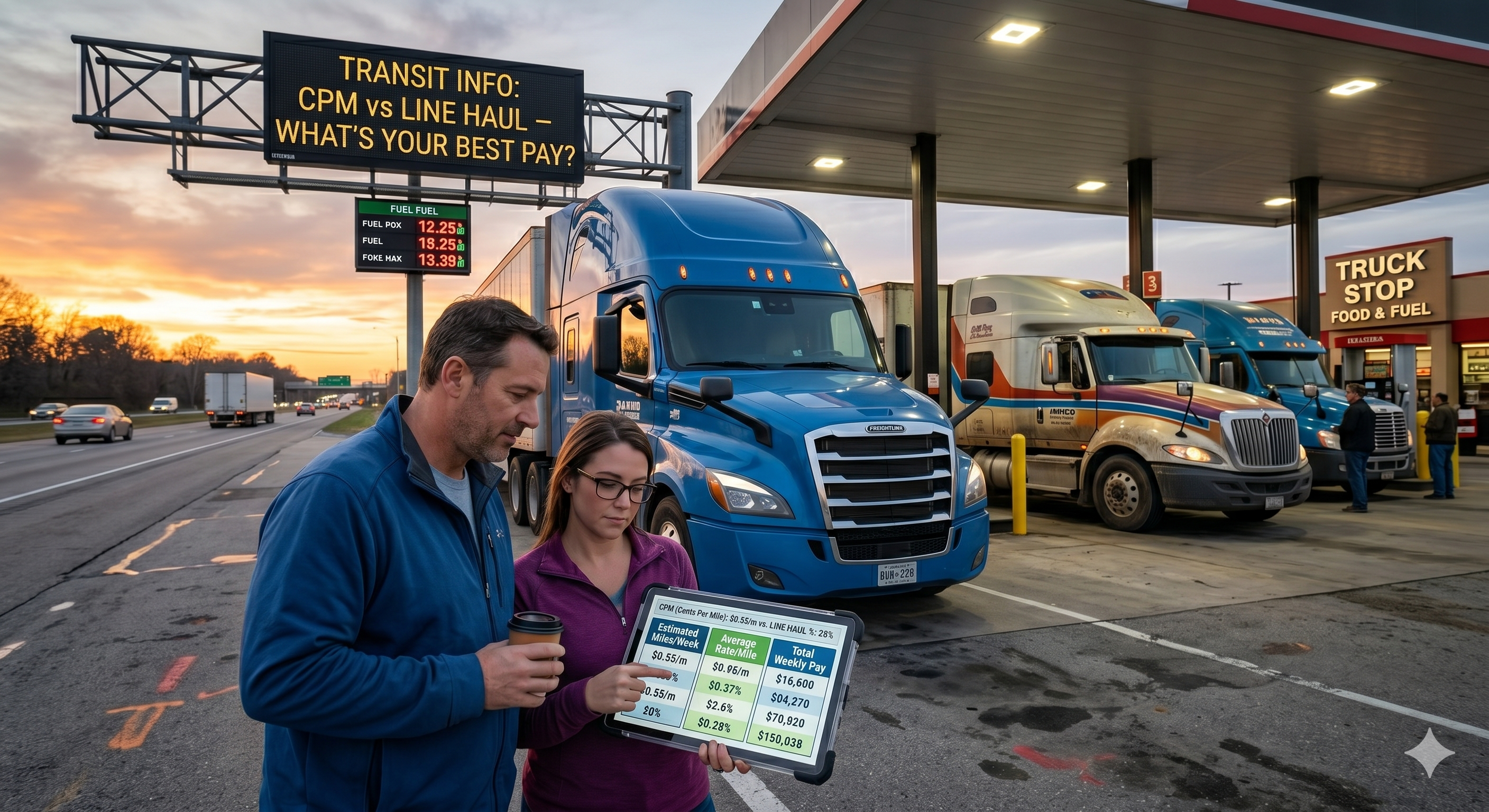
One of the most confusing parts of evaluating a trucking job offer is comparing apples to oranges. A carrier advertising $0.68 CPM sounds better than one advertising $0.62 — until you realize the first carrier runs you 2,200 miles a week and the second runs you 2,900. Or that one uses practical miles and the other uses household miles. Or that one has a per diem structure that cuts your taxable income significantly and the other doesn't.
Pay structure in trucking is more complicated than a single number, and understanding how each model works — and which one fits your situation — is how you make the decision that actually serves you.
The Pay Models in Use Today
Cents Per Mile (CPM) — The OTR Standard
CPM is the dominant pay model for OTR and long-haul driving. Typical rates range from $0.45 to $0.70 CPM for company drivers, with top carriers and experienced drivers reaching $0.65 to $0.80 CPM. The key factor is how many miles the carrier keeps you running — a great CPM rate means nothing if you're sitting without loads. TruckersHire
The math on CPM is simple: if you run 2,800 miles in a week at $0.60 CPM, you gross $1,680. If your carrier's dispatch is weak and you only run 1,900 miles, you gross $1,140 at the same rate. CPM rewards miles, not hours — which means it rewards you when freight is moving and punishes you when it isn't.
The hidden variable most drivers overlook is how miles are calculated. Carriers can use household miles (short miles), practical miles, or actual GPS miles — and the difference between the two can be 5–12% on any given lane. A carrier paying $0.60 CPM on practical miles may net you more than one paying $0.63 on household miles depending on the route. CPM looks attractive on paper but hides the real cost of unpaid time. Allpronow Detention waits, loading and unloading time, and dispatch gaps are all time you're working without earning mileage pay unless the carrier has specific provisions for them.
CPM works best for: Experienced OTR drivers who run consistent high miles, understand their routes, and have confidence in their carrier's dispatch capability.
Hourly Pay — Stability Over Ceiling
Hourly pay can offer greater income stability and is more common in local or regional routes. CDL Jobs Linker You're compensated for all working hours — including waiting, loading, and driving — which makes it the more predictable structure week to week.
The tradeoff is earning ceiling. An hourly driver's income is capped by available hours, while a CPM driver running strong miles can outpace an hourly driver significantly. Local drivers in major metros often earn well hourly — in New York, local hourly rates in 2026 range from $28 to $38 per hour, with drivers on 50-hour weeks earning $1,500 to $2,000. HMD Trucking But those same drivers are dealing with city traffic, dock congestion, and the stress that comes with dense urban delivery.
Hourly works best for: Local and regional drivers who want income predictability and are paid for all time worked, including non-driving hours.
Percentage of Load — Owner-Operator Territory
Percentage pay is most commonly offered to owner-operators leased to a carrier. Owner-operators most commonly use this method, as it splits freight revenue at an agreed percentage. Owner-operators typically earn 70–85% of the load rate, while company drivers on percentage structures typically see 25–35%. Upper Inc
The appeal of percentage pay is that it scales with load value. When rates are high — as they are in the current tightening market — percentage pay can be very lucrative. When rates are soft or you're running cheap freight, the same percentage produces disappointing numbers.
For company drivers, percentage pay is not recommended — it's an unreliable method and difficult to verify. For owner-operators, much of the financial success of this method depends strictly on which company you're leased to. Smart Trucking A bad carrier with low-paying freight will produce poor percentage results regardless of the math on paper.
Percentage works best for: Experienced owner-operators with authority who can evaluate freight quality and negotiate broker rates — not for company drivers who have no control over load selection.
Fixed Salary — Rare but Exists
Fixed salary jobs are very few in the trucking industry. You're paid the same amount regardless of mileage, hours, or load hauled throughout the contract period. Upper Inc Private fleet driving for major retailers (Walmart, Amazon, Sysco) is the most common context where salary-based pay appears in trucking.
Private fleet drivers typically earn $90,000 to $100,000 annually CDL Consultants — competitive pay, consistent schedule, and home time that OTR can't match. The downside is limited availability and typically a more rigid hiring bar (multi-year experience, spotless record, regional driving only).
Salary works best for: Experienced drivers who prioritize predictability and quality of life over income ceiling and can access private fleet or dedicated positions that offer it.
Beyond the Base: The Variables That Change Everything
Whatever base pay structure you're evaluating, the following variables can swing your effective annual income by $10,000 or more.
Per diem. Per diem pay is a critical, often-overlooked component. CDL Jobs Linker A carrier that structures part of your pay as non-taxable per diem reduces your taxable income — which means more take-home on the same gross pay. The current IRS rate is $80 per day, 80% deductible for owner-operators. Company driver per diem programs vary — evaluate them carefully against offers without per diem by calculating your actual take-home, not gross.
Miles guarantee. Some carriers — particularly dedicated and private fleet operations — offer guaranteed weekly miles or minimum weekly pay. On a CPM structure, a mileage guarantee converts an upside-dependent variable into a floor. That's worth real money in slow freight periods.
Detention and stop pay. Most CPM carriers now pay detention after two hours at a shipper or receiver, but the rate and trigger varies. A carrier paying $20/hour detention after two hours is meaningfully different from one paying $15/hour after three hours — and the difference compounds over a year of OTR runs.
Benefits value. Benefits packages can add $10,000 to $20,000 in total compensation value: health insurance, 401(k) matching of 3–6%, paid time off of one to two weeks in the first year, and per diem allowances. TruckersHire A carrier paying $0.61 CPM with strong health coverage and 401(k) matching may be worth more total compensation than a carrier paying $0.65 CPM with minimal benefits.
Safety and performance bonuses. As covered in the safety bonus article, structured bonus programs can add $2,000–$5,000 per year for drivers who earn them consistently. Factor this in when comparing offers from carriers with clearly defined bonus programs.
Comparing Offers: The Right Framework
When you're holding two offers side by side, don't compare headline CPM. Compare effective weekly gross under realistic conditions.
Ask every carrier the same set of questions:
- What does an average driver at your carrier gross per week — not the top earner, the average?
- How are miles calculated — household, practical, or actual?
- What's the average weekly mileage for a driver on my type of route?
- How is detention handled and when does it kick in?
- What's the per diem structure and how does it affect my tax situation?
- What benefits are available and when do I become eligible?
Drivers want to know exactly what they will earn per mile, per stop, or per load, and how factors like detention, layovers, or breakdowns are compensated. Unclear pay structures create frustration and mistrust, while transparency builds confidence and loyalty. Predictable income matters just as much as high advertised rates. Drive My Way
A recruiter who can answer all of those questions specifically is a recruiter representing a carrier with its act together. A recruiter who deflects or can only quote the maximum possible number is telling you something important about what the actual experience will be.
Which Structure Fits Where You Are
If you're in the first year with a clean record and building experience, CPM with a guaranteed minimum at a carrier with strong dispatch is the right entry point. Maximize miles, build your PSP, and position yourself to negotiate upward at the 12-month mark.
If you're two to three years in with a clean record, you should be targeting $0.62–$0.70+ CPM with a carrier that runs you consistently — or actively exploring dedicated lanes, team driving, or specialty freight that bumps the rate.
If you're an experienced driver prioritizing quality of life, dedicated or private fleet positions with guaranteed miles and strong home time are worth a CPM tradeoff. The math on stress and home time has real value even if it doesn't show up in gross pay.
If you're considering owner-operator, the income potential is real — owner-operators who manage their business well commonly net $100,000 or more after expenses TruckersHire — but the risk management, fuel exposure, and administrative overhead require real preparation. The current market environment with tightening capacity and rising rates is more favorable for new owner-operators than the oversupply years of 2023–2024, but going in without understanding your cost-per-mile is still how owner-operators fail.
At OTR Express Group, we work with CDL-A OTR drivers to match them with carriers whose pay structures actually fit their situation — not just the highest CPM on paper. If you want to talk through what a real offer comparison looks like for where you are in your career, reach out.
OTR Express Group | CDL-A OTR Driver Recruiting