Most CDL-A drivers know they're underpaid. They know the freight market is tightening, that carriers are competing harder for qualified drivers, and that their skills are genuinely in demand. What a lot of drivers don't know is how to convert that leverage into an actual conversation — and walk away with more money, better lanes, or both.
Negotiating in trucking isn't like negotiating a corporate salary. The dynamics are different, the variables are different, and the power shifts faster than most industries. Here's how to think about it in 2026.
The Market Is On Your Side Right Now
Before you negotiate anything, understand the environment you're operating in. Driver supply is tightening at its fastest pace in several years, spot and contract rates are rising, and capacity is contracting. ACT Research Carriers aren't adding trucks to compensate — they're competing harder for the qualified drivers already on the road.
Average sign-on bonuses rose to $7,800 among top carriers, signaling strong competition for driver talent. CDL Jobs Linker That number doesn't exist in a vacuum — it reflects what carriers are willing to pay upfront just to get a driver through the door. If they're offering $7,800 before you've turned a wheel, they have room in the rate structure.
The driver shortage is your leverage. Use it — but use it intelligently.
Know Your Actual Market Value Before You Open Your Mouth
The biggest mistake drivers make in pay conversations is going in with a gut feeling instead of data. Carriers negotiate these conversations all day. You need to come prepared.
Negotiate based on data. Know what competing carriers pay, and use your clean record and experience as leverage. TruckersHire
Here's how to build that picture before you make a call:
Check what comparable drivers are actually earning. Trucking forums like TruckersReport, driver-facing Facebook groups, and salary aggregators like Glassdoor and ZipRecruiter all have self-reported pay data. It's imperfect, but it gives you a real-world range. One OTR driver running out of Dallas reported hitting $0.62 CPM and around $85,000 last year, noting that a clean record is everything when you renegotiate. Yotru
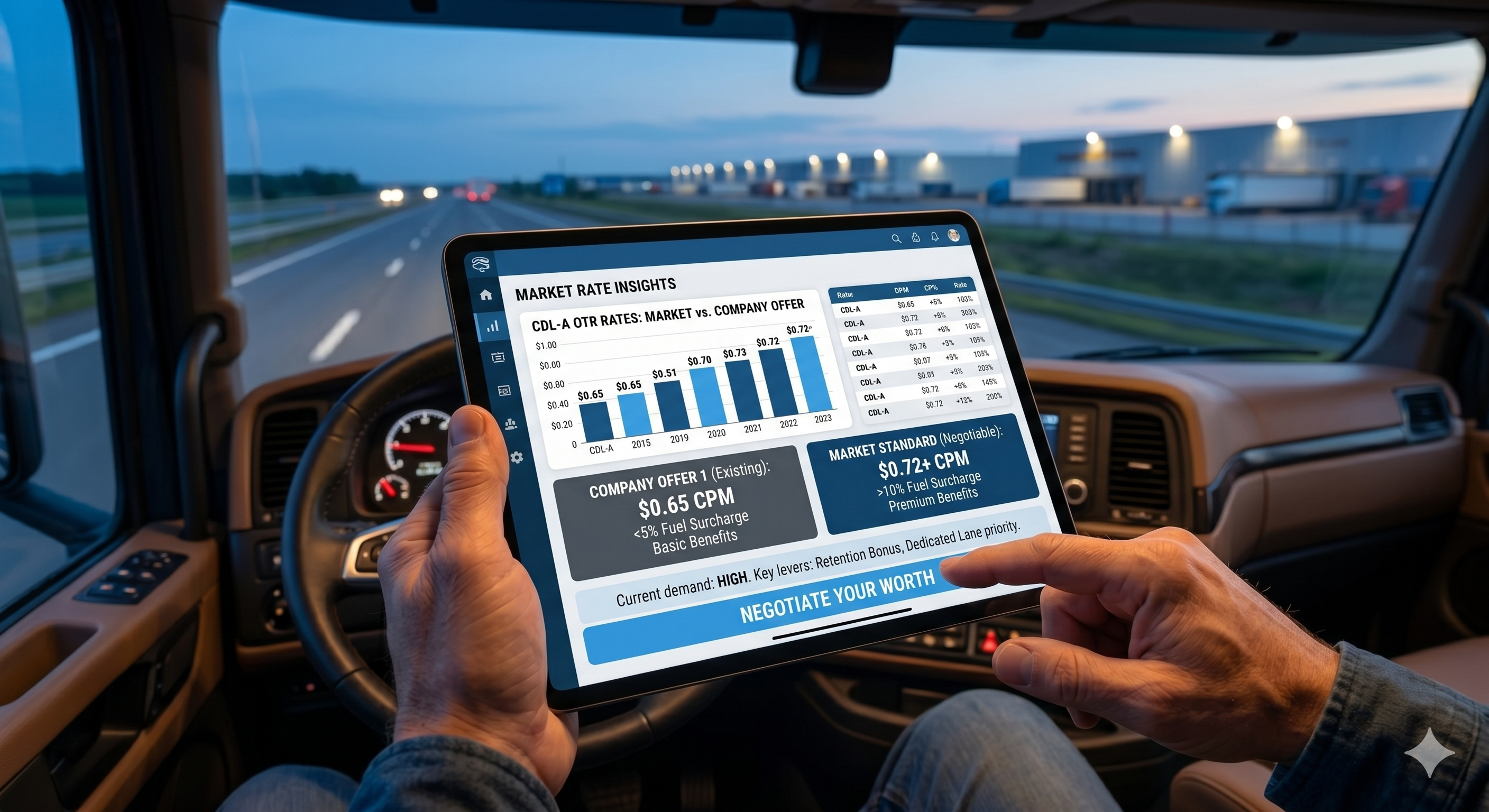
Know the CPM ranges for your freight type and experience level. Most carriers start new drivers at $0.40 to $0.50 per mile for OTR positions, with pay increasing significantly after the first 6 to 12 months. Experienced drivers with endorsements or specialized equipment experience earn at the higher end of the range. TruckersHire
Factor in everything beyond base CPM. Per diem structure, fuel surcharges, detention pay, stop pay, and bonus programs all affect your real take-home. A carrier paying $0.58 CPM with a weak per diem structure may net you less than one paying $0.54 with strong per diem and regular detention pay.
What Gives You Leverage — and What Doesn't
Not every driver walks into a negotiation with the same cards. Understanding what actually moves the needle helps you play what you have.
Clean CSA score and safety record. This is the single most valuable asset a CDL-A driver can hold in a pay negotiation. A clean record is key — PSP and CSA issues limit access to top-paying roles, and even minor violations like speeding or equipment issues add points, inflate CSA scores, and can reduce earnings through higher insurance costs or job restrictions. CDL Consultants A driver with a spotless record has standing to ask for more — and a carrier has financial incentive to pay it.
Endorsements. A HazMat or Tanker endorsement can add $5,000 to $15,000 per year. TruckersHire If you don't have them, getting them is one of the highest-ROI moves available to a CDL-A driver. The cost is minimal; the pay bump is real and compounding.
Experience and tenure. Most carriers have graduated pay scales with significant bumps at 6 months, 1 year, and 2 years of experience. TruckersHire If you're approaching one of those benchmarks, that's a natural moment to initiate a pay conversation — not to wait and see if the carrier notices.
Freight type specialization. Flatbed and tanker drivers generally out-earn dry van drivers because of the additional skills required. Equipment type consistently affects CPM. TruckersHire If you've been running dry van and you're willing to learn flatbed or specialized freight, that transition is worth quantifying before you negotiate.
What doesn't give you leverage: a recent accident, a violation on your PSP, gaps in verifiable mileage, or a checkered work history. If any of those apply, the focus should be on repairing those first — the negotiating position improves once the record does.
How to Actually Have the Conversation
Knowing your value and being able to communicate it are two different skills. Here's how to approach the conversation without burning the relationship or pricing yourself out.
Pick the right timing. Don't negotiate when you're in a bad spot — low on cash, between loads, or fresh off a problem with your current carrier. Negotiate from a position of stability: good recent miles, clean inspection, strong tenure. The carrier should feel like they'd lose something if you walked.
Be specific, not vague. "I think I deserve more" is easy to dismiss. "I've run 115,000 miles in the last 12 months, I have zero violations, and carriers in this lane are currently paying between $0.60 and $0.65 CPM — I'd like to revisit my rate" is a different conversation. Specificity signals preparation and confidence.
Negotiate the whole package, not just CPM. Home time has emerged as a critical retention factor — drivers increasingly prioritize time with family and consistency in scheduling, and improving scheduling transparency and home time availability are crucial steps in building compensation packages that address driver demands. CDL Jobs Linker If they can't move on CPM, ask about dedicated lanes, guaranteed miles, better equipment, or home time frequency. These have real dollar value.
Have a number and hold it. Vague asks get vague answers. Come in with a specific CPM target or a clear description of what needs to change. If they can't meet it, that's information — it tells you whether this carrier can offer what you're worth, or whether you need to be having this conversation somewhere else.
When to Walk — and Where to Go
Sometimes the answer to a pay negotiation is that the carrier can't or won't pay market rate. That's not a personal failure — it's useful information.
The trucking industry is undergoing significant change, and empowerment comes from having access to reliable information, being organized, and confidently negotiating terms that reflect the true value of your labor. CDL Jobs Linker
If a carrier is consistently below market and unwilling to move, the most effective negotiation is switching to one that already pays correctly. In a market where carriers are offering $7,800 sign-on bonuses and CPM rates are trending up, there's no reason to stay underpaid out of inertia.
The best leverage of all is a competitive offer from a carrier that wants you. You don't have to accept it to use it — but having it changes the entire tone of a pay conversation with your current carrier.
The Long Game: Build the Asset, Then Negotiate It
Pay negotiation in trucking isn't a one-time event. It's an ongoing process tied to the asset you're building — your safety record, your endorsements, your mileage consistency, your professional reputation.
Owner-operators who manage their business well commonly net $100,000 or more after expenses. Specialized freight like hazmat and oversized loads consistently produces the strongest pay growth. TruckersHire The drivers at the top of the pay scale didn't get there by accepting the first offer. They built records worth paying for — and then made sure they were getting paid accordingly.
At OTR Express Group, we work with CDL-A OTR drivers to match them with carriers that pay competitively for what experienced drivers actually bring to the table. If you're not sure whether you're being compensated fairly for your miles, your record, and your experience — let's have that conversation.
OTR Express Group | CDL-A OTR Driver Recruiting